Newsroom | Climate adaptation in practice: lessons from the field
At the France Invest Climate Working Group restitution breakfast, two companies specialising in adaptation solutions shared their field experience: Osmaïa, an ecological engineering firm, and Vertical Sea, a planning and construction advisory and engineering practice. Their testimonies shed light on a two-part reality: operational impacts are already well present across businesses, and a wealth of concrete solutions, provided the mistakes of the past are not repeated.
The climate impacts are already here, and they are financially material
The first takeaway from these exchanges is that physical climate risks are no longer prospective scenarios. They are already affecting business continuity today, with direct consequences on revenue and production conditions.
Several striking examples were cited:
- A production site of one of France’s leading aerospace manufacturers: production had to be suspended for several weeks in summer, metal buildings becoming unusable during intense heat episodes, aggravated by urban heat islands.
- Nuclear power plant in France: in 2025, a jellyfish invasion linked to the warming of seawater forced a temporary shutdown of the facility.
- A major French commercial port: the proliferation of mosquitoes now makes certain outdoor working conditions untenable during specific periods of the year.
- Leisure sector: a bicycle rental company sees demand drop sharply during heatwaves, with no anticipation mechanism in place.
These situations illustrate a point raised by the speakers: the impact of a climate hazard does not affect a company uniformly. Within the same factory, a gluten-free production line and a chocolate production line will not be exposed in the same way to a heatwave. The analysis must go down to the level of the industrial process, and extend up to the entire value chain, including suppliers and logistics.

What to avoid: the cost of maladaptation
Before turning to solutions, the speakers emphasised a common pitfall: maladaptation, responses that appear protective in the short term but prove costly, ineffective or counterproductive as climate events intensify.
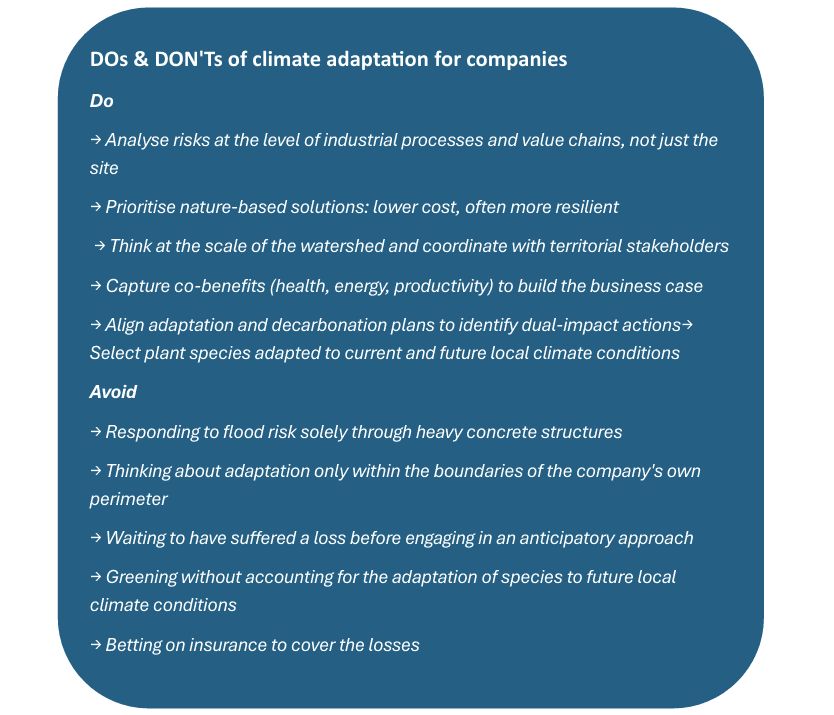
Over-reliance on civil engineering is the most documented example. In a mountain valley of 3,000 inhabitants, dikes and retaining walls have been rebuilt four times, at an estimated total cost of €3 billion, without ever achieving lasting protection against increasingly intense floods. Concrete and traditional "hard point" structures give way under extreme events, while also being the most expensive solutions.
Poor selection of plant species in greening projects is another concrete example: planting species ill-adapted to the local soil or climate can accelerate the degradation of ecosystems rather than strengthen them. Nature-based adaptation requires precise knowledge of local ecosystems.
What works: nature-based solutions, often at lower cost
In response to the limits of traditional civil engineering, the speakers presented an approach gaining significant momentum: nature-based solutions (NbS), driven notably by ecological engineering. These approaches rely on the natural functions of ecosystems to reduce risk exposure, often at costs well below those of conventional infrastructure.
Two concrete examples from Osmaïa's experience:
- Protecting a campsite against flooding: the creation of brushwood groynes to divert water flow, cost: €80,000, compared to several million euros for an equivalent concrete structure.
- Dune replenishment at Lacanau: fixing sand using pine branches to rebuild the natural dune, cost: €120,000 per hectare, a reversible solution maintained over time by the vegetation itself.
These examples illustrate a principle shared by all speakers: green spaces and natural environments serve a technical function, not just an aesthetic one. They absorb water, regulate heat, stabilise soils, and concretely reduce exposure to climate hazards.
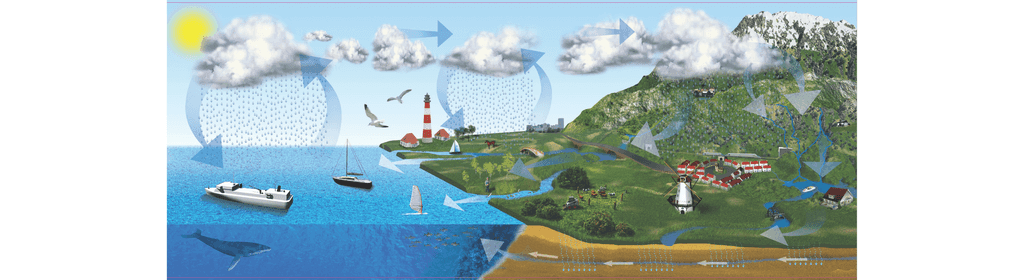
One figure was cited to illustrate the degradation of this function: the transit time for a drop of water to reach the sea has fallen from 30 to 60 days historically to just 2 days today, a sign of massive soil sealing that mechanically worsens flood risk and reduces groundwater recharge.
Thinking at the scale of the watershed, not just the site
A further key lesson from the discussion concerns the scale at which to reason. Companies can no longer conceive their adaptation solely at the level of their factory or plot: water and biodiversity do not stop at cadastral boundaries.
The speakers underlined the need to think in terms of watersheds, in coordination with local authorities, other economic actors in the territory, and managers of the surrounding natural environments. An isolated adaptation approach, designed without accounting for upstream and downstream dynamics, risks being ineffective or simply displacing the risk onto other actors.
The ROI of adaptation: a real challenge, with concrete levers
The speakers acknowledged a structural difficulty: it is hard to convince a private actor to invest in adaptation without having first experienced a disaster. The logic of anticipation remains less natural than the logic of reaction, and the return on investment of preventive measures is inherently difficult to quantify.
Two levers were put forward to address this:
Capturing co-benefits. Many adaptation actions generate positive effects across other dimensions, economic, social or environmental, that reinforce their financial justification:
- Insulating a building protects against heat (adaptation) and reduces energy consumption (decarbonation).
- De-sealing car parks (as considered at Airbus) improves water retention, cools the air and contributes to employee well-being and productivity.
Aligning adaptation and decarbonation. Some actions serve both objectives simultaneously. Where this is the case, it becomes possible to reprioritise within a transition plan: a decarbonation action that also protects against an identified climate risk can be moved up the list of priorities.
This article is based on the exchanges from the roundtable of 7 May 2025, organised as part of the restitution of the Climate Working Group of the France Invest Sustainability Commission, in partnership with Blunomy. The deliverables produced through this work, a reference guide on climate adaptation and the Climate Adaptation Toolkit for Private Equity Funds, are available for download at [link].
Also, in this series → Climate risks and adaptation: how private equity funds are moving to action Learn more about how ADEME Investissement, IK Partners and Siparex are integrating physical climate risks into their investment processes, from due diligence to portfolio monitoring.


