Resilience as value protection: why climate adaptation is now a core data centre investment decision


AI demand is driving a record data centre build-out just as physical climate risk intensifies. With asset lives of 20–30 years, the capacity built today faces decades of exposure to heat, water stress, floods and storms. Annual climate losses to data centres are projected to double to USD 168 billion by 2065.
This article explains where these losses fall and why adaptation protects value, through better efficiency, uptime, financing and insurance. It sets out four actions owners and operators can take to make resilience a core investment decision.
1.CAPACITY COMMITTED TODAY WILL CARRY CLIMATE RISK FOR 20–30 YEARS
AI demand is driving the largest data centre build-out in the industry's history. In June–July 2026 alone, publicly announced projects totalled roughly 21.6 GW of new capacity , against an installed base of 68.6 GW today , amounting to about a third of all capacity built to date. This capacity is being committed at a record pace, at the same time as physical climate risk is intensifying and will continue to do so in the coming decades. Once built, data centres have an asset life of 20–30 years, which means today's siting choices can result in decades of exposure to physical climate risks like heat-waves, typhoons and droughts. Existing data centre fleets face the same problem. First Street, the MSCI-owned climate-risk analytics firm, estimates that 79% of global data centre capacity sits in markets with elevated flood, wind or wildfire exposure, and 54% operates above thresholds for heat or drought . Data centre owners and operators will need to understand the physical climate risks their assets face and adapt to them.
2.THE COST OF INACTION: CLIMATE LOSSES SET TO DOU-BLE BY 2065, AND THEY LAND UNEVENLY
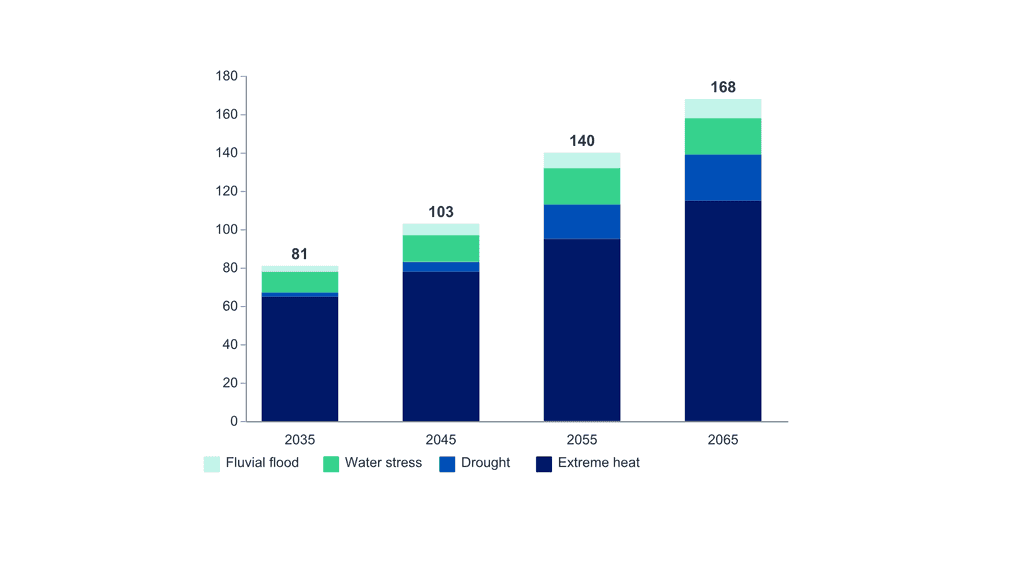
The World Economic Forum (WEF) projects annual global losses to data centres from physical climate risks to double from USD 81 billion in 2035 to USD 168 billion by 2065 under a high-emissions scenario (SSP5-8.5) . Extreme heat leads to the highest annual losses, followed by water stress, droughts and fluvial flood-ing. Climate hazards like wildfire and subsidence (not represented in the graph) add material exposure in specific geographies.
Figure 1: Global annual losses (USD billion) between 2035 and 2065, split by climate risk
Global totals conceal where the losses land. Combining the WEF loss projections with First Street's expo-sure data on a capacity-weighted basis, Blunomy estimated the distribution of global annual losses across APAC, the Americas and EMEA.
Figure 2: Global annual losses (USD billion) between 2035 and 2065, split by region
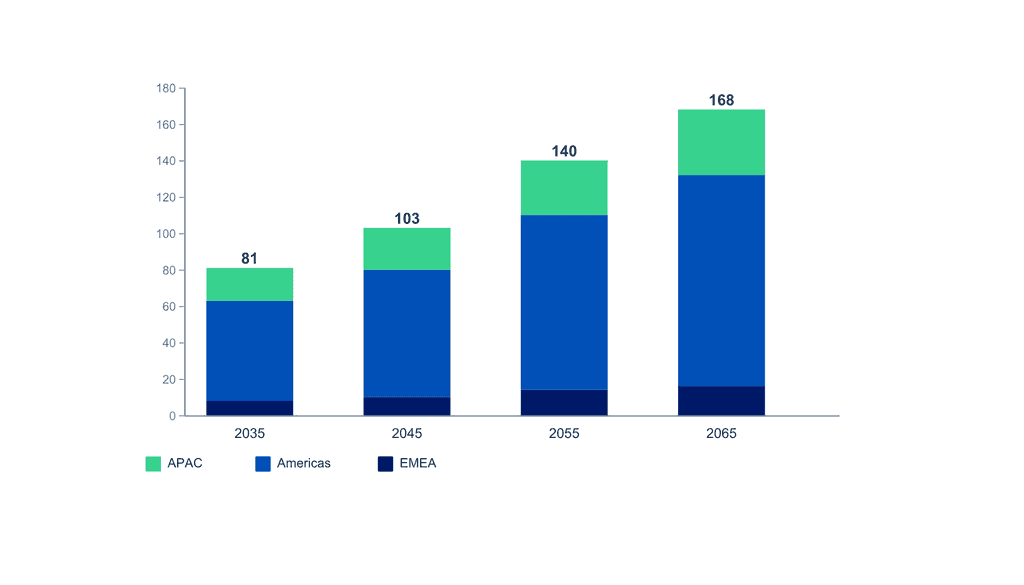
Our estimate puts the largest absolute exposure in the Americas, followed by APAC. Each region has differ-ent climate characteristics, though exact exposure varies from data centre to data centre:
- Americas — largest capacity share (65%), with higher acute exposure and lower chronic losses. Northern Virginia, the world's largest data centre market at 11.3 GW, carries hurricane, severe-storm and fluvial-flood exposure. Southwestern states, including Texas and Arizona, face the chron-ic combination of heat and water stress.
- APAC — outsized losses despite only an 18% capacity share, driven by high risk exposure. Equa-torial clustering across Malaysia, Singapore and Indonesia drives high heat and water stress expo-sure, degrading cooling efficiency and raising operating costs. Acute exposure is concentrated in monsoon flooding across India and Indonesia, and typhoons in Japan and Taiwan.
- EMEA — lowest exposure on both axes. Chronic exposure is concentrated in Mediterranean Eu-rope, which faces intensifying heat and water stress, but will become increasingly relevant across the rest of Europe. Acute exposure is narrow, with Amsterdam's structural flood risk a rare excep-tion.
Zooming in to the local level, three documented cases demonstrate how physical climate risks are already impacting data centres:
- In June 2026, a heatwave caused chillers at the on-site data centre of Queen Alexandra Hospital in Portsmouth, UK, to fail. This led to digital service and air conditioning outages at the hospital, im-pacting patients’ physical comfort as well as planned care and appointments.
- In September 2024, Hurricane Helene caused an outage at the National Centers for Environmental Information (NCEI) data centre in North Carolina, interrupting, for over 20 days, the availability of climate data relied on by other US agencies. Hurricane Helene brought historic rainfall and was the costliest natural disaster in North Carolina's history .
- In July 2022, a UK heatwave peaking at 40°C forced both Google and Oracle to power down data centres in London . Google's incident report describes a simultaneous failure of multiple redundant cooling systems, with capacity deliberately shut down to prevent hardware damage. Similarly, Or-acle's South London facility powered down service infrastructure for the same reason. Both opera-tors saw service disruption for a few hours before rectifying the failures, with multiple small and medium-sized enterprises (SMEs) losing out on revenue , demonstrating how climate hazards can materially impact data centres.
These examples re-emphasise the impact of physical climate risks like heatwaves and extreme weather. They also show that the impact on data centres extends beyond the actual building and implicates the val-ue chain (e.g. power supply, cooling equipment and water supply).
3.ADAPTATION PAYS BACK THROUGH EFFICIENCY, UP-TIME, CHEAPER CAPITAL AND LOWER INSURANCE
Beyond risk reduction, climate adaptation can be a core value-creation lever for data centres. Addressing local climate hazards can allow data centres to operate more efficiently, increase reliability, attract favour-able capital and reduce insurance costs.
Figure 3: Business benefits of climate-adapted data centres
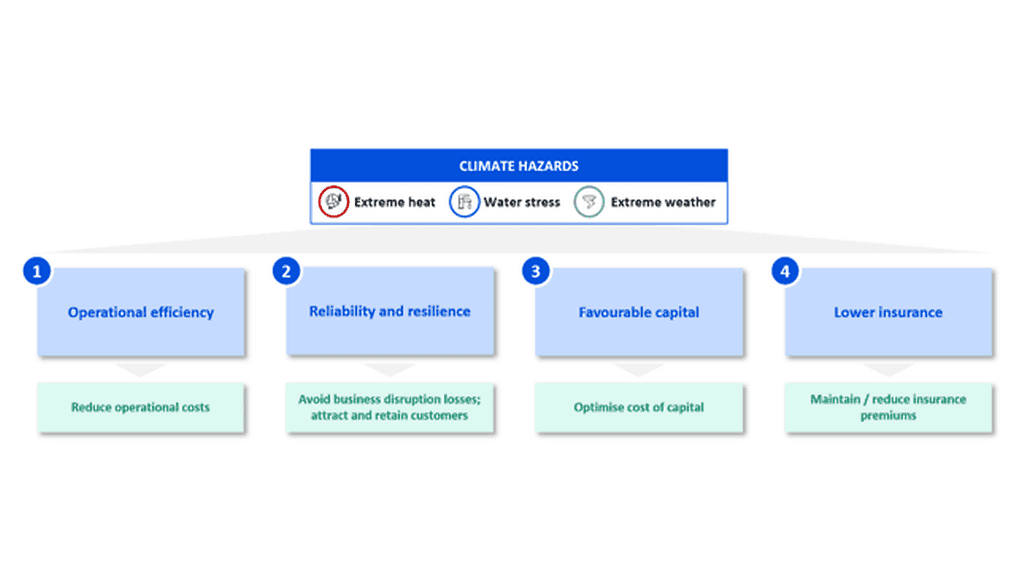
- Operational efficiency – Advanced adaptation solutions such as moving from air cooling to ad-vanced liquid architectures reduce energy operating costs materially per unit of IT load, improving Power Usage Effectiveness (PUE) and Water Usage Effectiveness (WUE) concurrently, two key per-formance indicators.
- Reliability and resilience – Adaptation protects service continuity and increases customer trust, helping data centre owners meet the Uptime Institute’s Tier Standards .
- Favourable capital – Institutional investors and lenders increasingly factor physical climate risk into investment and credit decisions. Assets with mature adaptation strategies can improve their fi-nancing position by attracting capital at favourable rates compared to peers with less-adapted as-sets.
- Lower insurance – Climate-adapted data centres can maintain stable insurance costs, or even de-crease their premiums, as expected losses rise industry-wide and impact unadapted data centres. Together, these support the commercial prize of winning and retaining hyperscale customers, whose relia-bility requirements make resilience a qualification criterion rather than a differentiator. Data centre adap-tation solutions to withstand chronic and acute climate risks revolve around cooling, power, and design and optimisation.
Together, these support the commercial prize of winning and retaining hyperscale customers, whose relia-bility requirements make resilience a qualification criterion rather than a differentiator. Data centre adap-tation solutions to withstand chronic and acute climate risks revolve around cooling, power, and design and optimisation.
Figure 4: Adaptation solutions by category and climate risk addressed
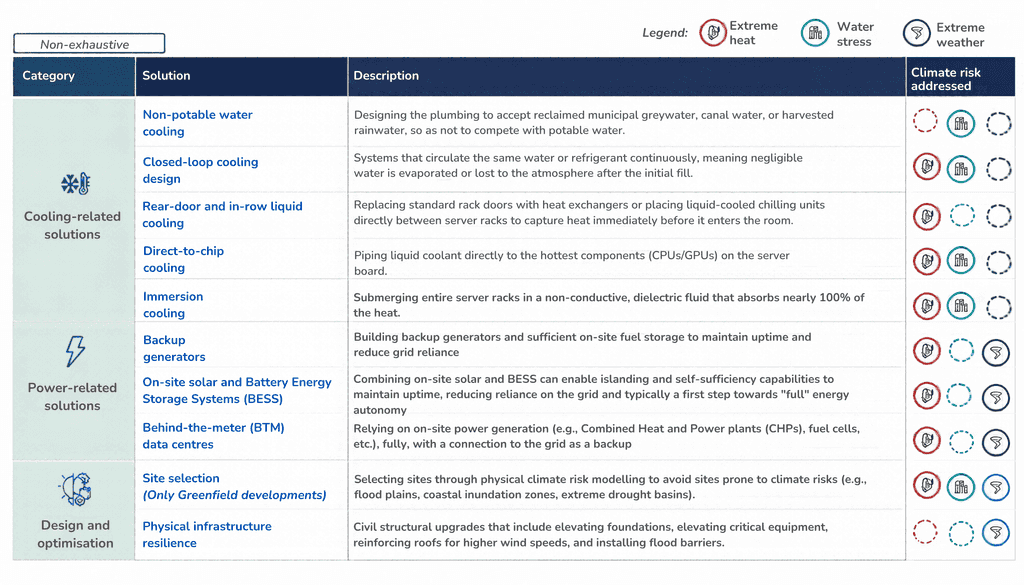
- Cooling – Data centres require a significant amount of cooling to prevent throttling, shutdowns and hardware damage from heat generated by servers. A large share of existing cooling solutions relies on water as the cooling medium, which comes under pressure during climate events such as droughts or in water-stressed areas. Additionally, a significant share of data centres is situated in equatorial and Mediterranean markets, which are increasingly subject to heat stress and extreme heat. Cooling-related solutions like closed-loop cooling designs and direct-to-chip cooling (using non-water-based coolants) address heat and water stress together by adopting water-light or wa-ter-free cooling.
- Power – Data centres are power-hungry assets and are typically reliant on drawing power from the local grid. During times of extreme heat or rising ambient temperatures, data centres need to draw on more power for cooling purposes, while competing with local communities and businesses. Power-related solutions allow data centres to meet some or all of their power needs locally, reduc-ing grid reliance and the risk of failure from grid disruption.
- Design and optimisation – With the increasing occurrence of climate hazards, greenfield and brownfield data centres will need to consider acute climate risks at various stages of the develop-ment cycle. These solutions involve proper site selection for greenfield data centres and adapting brownfield data centres with physical solutions like elevating foundations and critical equipment, reinforcing roofs for higher wind loads and installing flood barriers.
Beyond protecting against physical climate risks, adaptation measures can also carry co-benefits like cli-mate mitigation or nature-based benefits, which will improve project acceptance by local communities and municipalities, and ensure regulatory alignment. For example, on-site solar and storage reduce both grid dependence and fossil fuel consumption. Water-light or water-free cooling reduces both water scarcity exposure and resource draw.
4. MAKING ADAPTATION A CORE INVESTMENT DECISION: FOUR ACTIONS FOR OWNERS AND OPERATORS
Physical climate risks could become a core operating variable for data centres in the near future, on par with power availability and land. Blunomy has identified four sequential actions that data centre owners and operators can take to safeguard their assets and benefit from improved climate resilience:
- Establish the risk baseline for brownfield assets and integrate climate exposure into site selec-tion for greenfield assets. For existing sites, model climate risk exposure at the asset level using forward-looking climate models and prioritise the most vulnerable assets. For new builds, make hazard screening a formal step in site selection, alongside power and land availability – a low-cost quick win.
- Weigh the benefits of water-light or water-free cooling designs against costs. To anticipate wa-ter scarcity, default to closed-loop or water-light systems, which can allow assets to operate in places where competitors run into water allocation limits.
- Prioritise utility reliability. Most outages are caused by the power, water, fuel, fibre and road ac-cess a site depends on, rather than damage to the physical data centre asset. Size backup power, build in redundancy for resupply and connectivity, and raise substations and critical equipment above flood levels.
- Position resilience commercially. Convert investment in climate adaptation into a market position by quantifying uptime performance against climate hazards for hyperscale customers, validating resilience evidence for insurers and lenders, and disclosing successes and results. Owners and operators that treat adaptation as a core part of their infrastructure strategy gain reliability that hyperscale customers will pay for, an operating cost advantage through better Power Usage Effective-ness (PUE) and Water Usage Effectiveness (WUE), and access to water- or power-constrained markets in which competitors cannot operate. On the flip side, owners and operators that treat adaptation as a com-pliance exercise face the reverse: downtime exposure that erodes Service Level Agreement (SLA) credibil-ity, rising insurance costs or withdrawal of cover, financing friction, and assets that become expensive to retrofit and difficult to sell.
Authors:
- Sophia Mikulits, Senior manager.
- Clifton Tan, consultant
Footnotes:
- Data Center Knowledge, 2026
- Cushman & Wakefield, 2026
- First Street, 2026
- World Economic Forum, 2025
- First Street is an MSCI-owned climate risk analytics firm
- The New York Times, 2024
- Uptime Institute