Hospitality & Climate risks: how resilience is becoming a foundation of financial valuation


European hospitality is consolidating at record pace just as physical climate risk intensifies. Heatwaves, water stress and extreme weather are changing where and when people travel: 81% of European travellers now adjust their destination and timing for climate reasons. Over the same period, insurance claims have risen sevenfold in 40 years.
This article explains how climate exposure is shifting from a CSR concern to a driver of valuation, through its effects on demand, operating margins and insurability. It sets out three steps hospitality groups can take to quantify risk, redirect capex to adaptation and make resilience part of the investment case for their next M&A deal or IPO.
2025–2026 has marked a capital "Big Bang" in European hospitality and tourism real estate: asset portfolios are consolidating at unprecedented velocity. Accor, Pierre & Vacances, Belambra, and emerging players like Friendly Hotels are reshaping the competitive landscape. Yet behind this M&A frenzy sits an uncomfortable truth that investors are only now pricing: a hotel's future revenues and profitability is no longer decoupled from its climate exposure.
The shift is stark: sustainability has moved from compliance cost center (CSR 1.0) to valuation mechanism (Financial Resilience 2.0). As Vincent Kientz, co-founder of Blunomy, has noted when working with major operators, we are witnessing the market price physical risk into asset multiples before climate events fully materialize. Those who act now will hedge their portfolio against 2030+ climate hazards; those who delay will face capital sanctions during their next exit or IPO.
Key Takeaways:
- Insurance claims have increased sevenfold over 40 years (KPMG): physical damage and operational interruption now directly impact EBITDA through insurance premiums, energy volatility, and maintenance spend.
- 81% of European travellers now alter destination and timing choices based on climate factors (ETC, 2025–2026). This is becoming a major redefinition of seasonality and destination attractiveness.
- In a consolidating market, Climate Vendor Due Diligence (VDD) is now table-stakes for M&A and IPO valuations. Investors increasingly deploy quantitative climate stress tests rather than qualitative ESG scores. A development plan lacking "sustainability-by-design" faces immediate valuation discount, stranded asset risk crystallizes on the balance sheet.
2026: when the capital shock meets physical reality
The summer of 2026 was a turning point. According to NOAA reports, global temperature records reached new highs; heatwaves spread across the Mediterranean, southern Spain, and eastern Europe; wildfires disrupted operations in multiple regions; water stress intensified in traditionally stable markets.
For the European hospitality market, this physical shock coincides with a major capital "Big Bang" (Les Echos, 2026): an intense phase of consolidation where asset portfolios are changing hands at an accelerated pace.
While hotel groups deploy aggressive development ambitions to erase the scars of 2020, the future profitability of these investments depends on a critical variable: physical and demand resilience under climate stress. This marks the hard pivot from CSR-as-risk-mitigation (the old paradigm: report the risks, manage the reputation) to Resilience-as-value-preservation (the new paradigm: quantify impact on cash flow, embed adaptation into capex, use it as a valuation thesis).
When climate uncertainty threatens hospitality groups and profitability
To understand why investors are moving from ESG scores to resilience stress-testing, it helps to trace the actual mechanisms. Climate change does not only threat infrastructure; it increasingly disrupts purchasing behavior. As a result, climate uncertainty is reshaping the geography and timing of profit.
Shifting geography and demand: 81% of Europeans now incorporate climate factors into their travel trade-offs (ETC, 2026).
- In regions like Andalusia, RevPAR (Revenue Per Available Room) is already seeing erosion during heat peaks as the senior demographic (a historical and loyal segment) flees extreme temperatures.
- Greece faced similar pressure: Athens and coastal resorts saw record temperatures in 2024 and again in 2026, triggering water restrictions and guest behavioural shifts.
- Japan is experiencing record typhoon threats in 2026, with meteorological forecasts projecting up to 28 tropical storms and 14 direct landfalls, nearly five times the historical average (Japan Meteorological Agency, 2026). Typhoon Jangmi in June 2026 triggered level-5 flood warnings and caused flight cancellations and railway disruptions across the hospitality and tourism sectors during peak season.
Operational cost volatility and margin erosion: For industry leaders such as Marriott and Accor, energy price volatility and local water stress are weighing heavily on operating margins. Cooling costs and water management are now critical performance drivers:
- Cooling costs can swing 30–50% year-over-year in Mediterranean properties during heat-driven demand spikes.
- In 2024–2025, the Rhône water-level crisis in France forced several hospitality operators to deploy emergency conservation measures (reduced-flush toilets, laundry-on-demand protocols, guest communication campaigns).
- Risk-Driven consolidation: In France, strategic moves (ranging from Pierre & Vacances’ acquisition of Camping Paradis to the Bpifrance-backed development of Friendly Hotels in mountain regions) demonstrate a hunger for external growth. Yet, without comprehensive climate audits, these acquisitions risk becoming "Stranded Assets" by 2040.
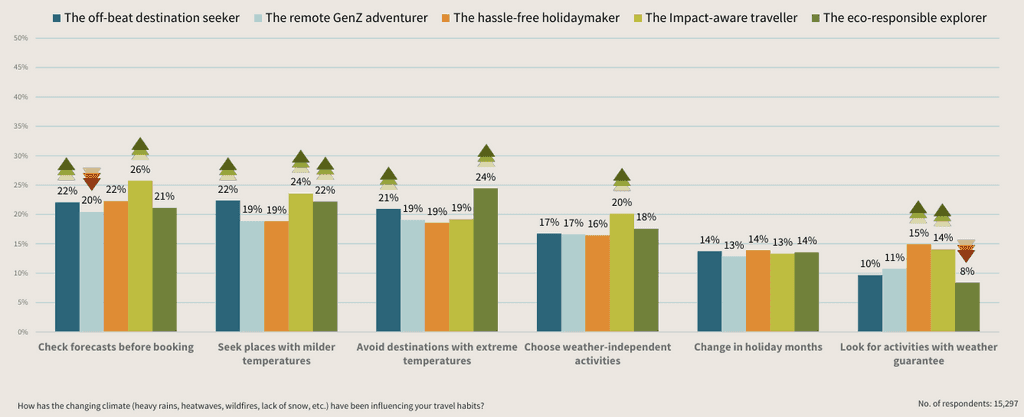
Most popular changes in travel habits due to climate change by segment (2026, ETC):
"How has the changing climate (heavy rains, heatwaves, wildfires,...) have been influencing your travel habits?" (15 287 respondants)
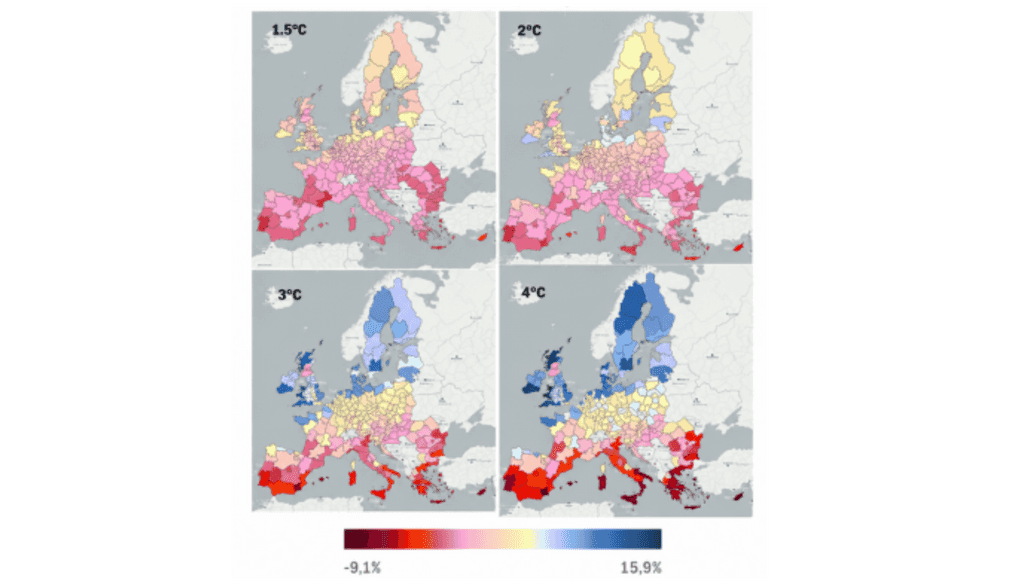
Projected evolution of the European tourism demand for all global warming scenarios, to the present (2019) in pourcentage terms:
(Source: JRC analysis. The values shown refer to RCP 8.5 emission scenario)
The necessary pivot toward financial resilience
Hotels are real estate assets whose cash flow depends on guest behaviour and physical operability. Hence, the value of a hospitality group is now increasingly through the lens of adaptation and resilience under increased climate constraints and therefore a quantitative climate stress-test (what is my energy cost exposure under +2°C, +3°C warming paths? when do operational interruptions kick in? where does demand shift?) and an adaptation CAPEX plan are becoming essential assets in any business plan.
Climate adaptation measures do not all have the same impact across the portfolio, making portfolio-level essential. Impacts materialise financially both through asset damages and operational disruptions, making the usual asset-level building-oriented approach only partially relevant.
As the European market experienced this intense M&A and capital reshuffling, investors have begun pivoting from qualitative ESG assessments to quantitative financial resilience modelling and Climate Vendor Due Diligence (VDD) has become an essential component of transactions.
For Vincent Kientz, the challenge lies in identifying and deploying solutions that create value while anticipating risks. A development plan lacking "Sustainability-by-design" (energy efficiency, resource management, circularity) faces an immediate valuation discount, as it represents a "stranded asset" risk in the mid-to-long term.
3 steps to build a strategic climate resiliency action plan: what/who’s at risk, what are the costs, what fixes it.
Hospitality groups must now accelerate the integration and implementation of climate risks and adaptation strategies. To help structure this assessment, Blunomy's resilience matrix framework breaks climate impact into three independent financial dimensions, each answering a fundamental question: what's at risk, who's at risk, what fixes it. Systematic Climate Vendor Due Diligence (VDD) then operationalizes these insights, transforming resilience analysis into valuation strategy.
Strategic climate resiliency action plan success relies on three strategic steps:
Step 1. Diagnose and quantify (Portfolio-level climate impact modelling)
This is no longer about checking regulatory boxes, executives must now model the income statement impact of physical risk throughout their portfolio, property by property, scenario by scenario. The metric that matters: how much EBITDA is at risk in a +2°C, +3°C world, and under which timeline does it materialize?
Blunomy structures portfolio diagnosis and quantification around three distinct lenses:
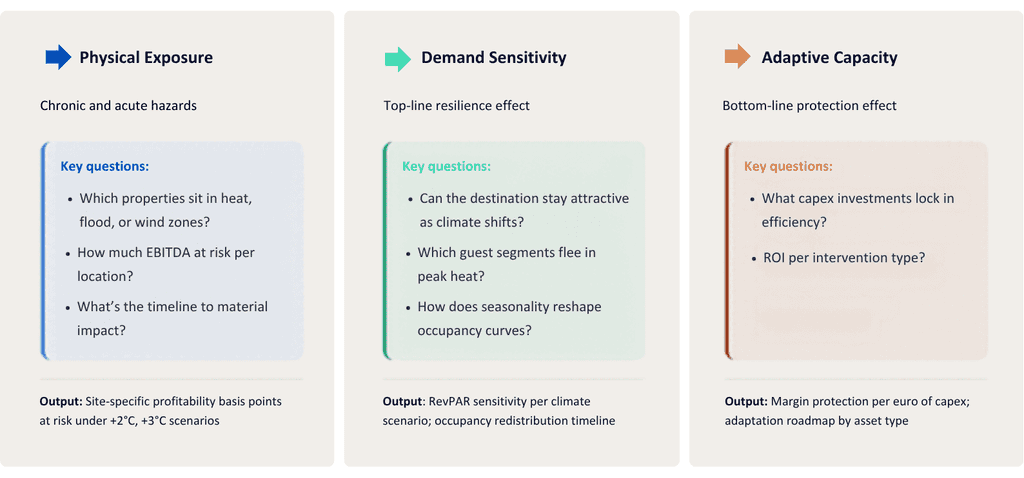
Resilience requires alignment between hotel owners, operators, guests, and suppliers. Leaders are those who model impact-reduction levers throughout their value chain. To translate these levers into capex strategy, a portfolio-level synthesis combines all three lenses to identify which assets are exposed-static (declining value, rising risk) versus adaptive-resilient (value-protective, margin-stable). Prioritize capex by highest margin-protection leverage. Use this matrix to model impact reduction across your portfolio and build climate-proof development plans for capital events.
Step 2. Realign CAPEX and operational processes (Adaptation)
Capex must be redeployed toward interventions that work both technically and economically: energy and water consumption reduction to hedge against price volatility and supply restrictions, deployment of architectural and technical solutions (bio-climatic design, passive cooling), structural fortification, and supply chain redundancy.
For both new builds and renovations, resilience must be integrated from the design phase to guarantee insurability and the future resale value of the real estate asset.
Step 3. Leverage resilience in exit strategy (Climate VDD as valuation thesis)
Every M&A and IPO transaction now requires systematic Climate Vendor Due Diligence: quantified exposure analysis, adaptation capex roadmap, and forward climate stress tests. Investors increasingly use these frameworks to tier assets into "exposed-static" (declining value, rising risk) and "adaptive-resilient" (value-protective, margin-stable).
For companies preparing for a capital increase, resilience must be at the heart of the equity story. Demonstrating that the growth trajectory is "climate-proof" is a powerful lever for securing a high valuation multiple.
Case studies
Case Study #1: Quantifying Resilience Across a Major European Portfolio
Context. When a leading French hospitality group set out to understand climate risk across its global portfolio, the challenge was not abstract: which properties would remain profitable under +2°C warming? Which guest segments would migrate? What investments would lock in margin protection? Rather than rely on high-level climate projections, the group partnered with Blunomy and Axa Climate to co-construct a climate transition narrative grounded in business fundamentals.
Approach developed. Working alongside the group's sustainability, strategy, and risk teams, we applied the IPCC's SSP2-4.5 central climate model across three dimensions: physical exposure (site-by-site flood, heat, and water-stress hazard mapping), demand sensitivity (geographic and demographic guest flow projections), and adaptive capacity (capex requirements per brand and owner type). As a result, properties have been clustered into three tiers: those facing near-term margin compression (coastal Mediterranean resorts, heat-exposed city centers), those with structural demand shifts (trekking-focused mountain lodges, seasonal beach properties), and those positioned to benefit from climate-driven migration patterns (alpine regions, cooler northern Europe).
The key outcome. specificity matters. Generic climate models produce generic conclusions. Business-specific models—anchored to geography, brand positioning, and owner incentives—reveal actionable levers. The group could now accelerate capex in adaptive-resilient assets, prepare exit strategies for exposed-static properties, and recalibrate development plans for new builds. This transition from portfolio-level risk assessment to capex deployment became the foundation for their next capital event and their competitive positioning through the 2030s.
From compliance to value creation
The hospitality sector's growth should not be managed blindly. As evidenced by Accor’s strategy of seeking new, less-exposed markets (Skift, 2026), resilience is becoming a strategic compass to preserve long-term value and secure renewing business horizons for tomorrow. Now is the time to consider climate resilience as a key investment strategy for future performance and no longer as a compliance burden and operational cost.
Author:
By Thomas Biget, manager at blunomy.
Sources & References
- NOAA (2026): Global Climate Monitoring Report
- European Travel Commission (2025–2026): Conscious Traveller Segments & Quarterly Reports
- KPMG: Loss Ratios and Climate Risks for Insurers
- Accor Integrated Report (2025)
- Marriott International (2025): Annual Report
- Skift (2026): The Net-Zero Club & Strategic Market Repositioning
- Les Echos (2026): Capital "Big Bang" in French Hospitality
- Gallagher Re (2024–2026): Insurance Market Outlook & Claims Analysis
- Bpifrance (2025): Strategic Development Note on Friendly Hotels & Alpine Positioning
- Japan Meteorological Agency (2026): Typhoon Season Forecast & Typhoon Jangmi Impact Reports