EU F-Gas Regulation: Why Cooling-as-a-Service is a strategic solution to the refrigerant transition


The EU’s F-gas regulation is forcing a structural shift in commercial refrigeration, transforming cooling systems from a business choice into an urgent compliance requirement. For many retailers and cold-chain operators, the primary barriers to switching to natural refrigerants aren't technical, but financial and operational.
This article explores how the phase-down of high-GWP refrigerants is driving the rise of "Cooling-as-a-Service" (CaaS) models. We analyze the opportunities for manufacturers, energy service companies, and infrastructure investors to bridge the capital gap, helping smaller and independent players decarbonize at pace while securing resilient, long-term revenue streams.
Replacing a cooling system has gone from a business choice to a regulatory deadline with the EU's F-gas phase-down is already in effect
Refrigeration is a critical system for food retailers and cold chain logistics operators. It runs continuously, every day, keeping food and other perishable goods within safe temperature ranges, and it is typically the single largest electricity consumer in a store, accounting for 35 to 50% of total energy use in a European supermarket. Replacing an ageing cooling system therefore carries a real efficiency upside on its own, since newer equipment consumes markedly less energy than the units it replaces. But for these operators, that decision has also stopped being one that can be deferred. It has become a compliance requirement.
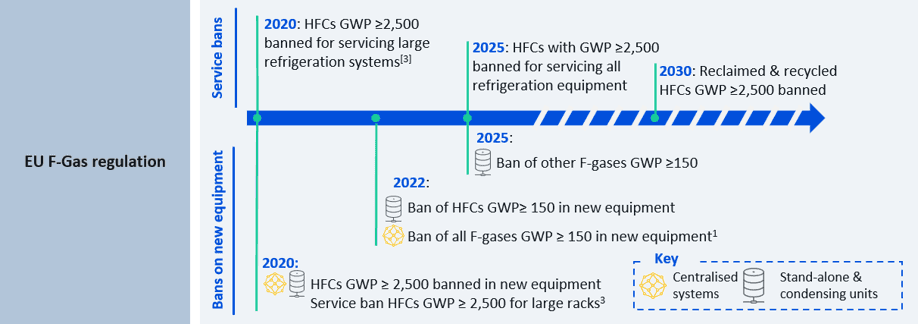
The trigger is the European Union's fluorinated greenhouse gases (F-gas) regulation (EU 2024/573). The regulation is designed to reduce the use of high-global-warming-potential F-gas, including the hydrofluorocarbons (HFCs) historically used in much commercial cooling equipment. These gases matter disproportionately for climate change: global warming potential (GWP) measures how much heat a gas traps in the atmosphere compared to carbon dioxide, and many refrigeration HFCs carry GWP values in the hundreds to thousands, meaning a leak of just one kilogram can have the same warming effect as a tonne or more of CO2. Because refrigeration equipment leaks gas over its lifetime, during installation, servicing, and disposal, phasing out these high-GWP refrigerants is one of the fastest available levers for cutting emissions. Since January 2025, new commercial refrigerators and freezers using F-gas with a global warming potential (GWP) of 150 or more can no longer be placed on the EU market; a threshold low enough to exclude virtually all standard HFCs.
The regulation also makes existing HFC-based systems progressively harder and more expensive to operate. An annual quota limits the volume of HFCs that can be placed on the EU market, with the permitted supply declining on a fixed path to zero by 2050. As available HFC supply tightens, the cost and availability of HFC for older systems is likely to become more challenging. From 1 January 2025, legacy equipment using HFCs with a GWP above 2,500 generally cannot be serviced with virgin gas, although reclaimed or recycled HFCs remain permitted until 2030. Together, these measures make it increasingly difficult and costly to maintain older HFC-based systems, further strengthening the case for replacement.
Some countries go further still. For example, Norway, Denmark and Spain have each layered a national tax on HFCs on top of the baseline EU framework, raising the running cost of HFC-based systems and adding a direct financial incentive to switch to CO2 refrigeration and other low-GWP alternatives. In Norway, the tax is set at EUR 0.143 per kg per GWP unit. For a 100 kg system running on R449A (GWP = 1,397) with an average annual leak rate of 15%, this results in an HFC tax of approximately EUR 3,000/year.
The technology to replace the old systems exists; the capital and internal capabilities to do it often don't
The underlying technology is not in question. Natural refrigerants (e.g., CO₂, ammonia and hydrocarbons), with a GWP of typically ~0-5 (>99% lower than HFCs), have long track records in commercial refrigeration. Many large retailers have already set their own targets to switch into these natural refrigerants:
- Carrefour launched an HFC phase-out plan targeting elimination from its EU operations by 2030 and globally by 2040; as of 2025, roughly 19% of its company-owned stores were HFC-free (excluding the franchise stores).
- Metro AG has committed to a 90% phase-down of HFCs globally by 2030 and a full phase-out by 2040, and had already converted more than half of its stores to natural refrigerants.
If the technology and the targets exist, the obstacle sits elsewhere: cost and capability. Replacing a refrigeration system requires significant upfront capital investment. Mid-sized operators, including regional chains, franchisees and independent cold-store operators, often lack both the balance-sheet capacity and the in-house engineering expertise needed to plan and execute the transition. The challenge compounds at portfolio scale: a retailer converting dozens or hundreds of stores must coordinate capital allocation, installation capacity and technical delivery across many sites at once, while keeping stores trading and refrigeration running throughout. Few operators have the internal project management bandwidth to run that as a self-managed programme.
Equipment manufacturers, energy service companies and infrastructure investors are positioned to capture this shift
This shift creates opportunities for two types of players on the supply side:
- Equipment manufacturers, who have historically sold refrigeration hardware as a one-time transaction, can reposition around long-term, recurring-revenue relationships instead, deepening the customer relationship and expanding the addressable market to operators that could never justify or afford an outright purchase.
- Energy service companies, which already operate on performance guarantees and long-term contracts in areas such as building efficiency, are well placed to extend that model to refrigeration by taking on monitoring, maintenance and energy optimisation as a service.
Infrastructure investors and lenders stand to benefit in parallel. A portfolio of long-duration CaaS contracts, each backed by essential cooling infrastructure and a contracted revenue stream, has characteristics that resemble other infrastructure-style asset classes: predictable cash flows, long tenors and an underlying asset that retains value. As the EU's regulatory deadline pushes more operators toward replacement, platforms built specifically around as a service models could become one of the more direct ways for capital to participate in the commercial cooling transition. This also allows investor and lender capital to positively contribute to the speed of emissions reduction from retiring HFCs, giving smaller and independent retailers the means to decarbonise at pace alongside larger chains.
Blunomy supports investors and industry players navigating this shift. For investors evaluating CaaS platforms, we conduct commercial due diligence and market sizing, assessing addressable demand by geography against regulatory timelines and legacy equipment stock. For equipment manufacturers and energy service companies building a CaaS offer, we help design the business model and go-to-market strategy, from structuring the offer to prioritizing which markets to enter first.
Authors:
- William Suryowidagdo, consultant
- Andy Butt, senior manager
- Safae El Fadili, managing partner