Newsroom | From Awareness to Bankability: What It Takes to Scale Nature-Based Solutions with TerraGRN
Nature-based solutions are gaining strategic attention, but turning that attention into investable, scalable systems remains a challenge. In a recent conversation, Blunomy Co-founder Vincent Kientz sat down with Sundar Bharadwaj, CEO of TerraGRN, to unpack what's really standing in the way, and what it will take to move the sector forward.
Building an infrastructure, not a project
TerraGRN was founded in the UK with a clear ambition: connect degraded landscapes to real industrial demand for sustainable materials, food, energy, and carbon. Its first project, in Mpumalanga, South Africa, restores degraded land through biodiverse agroforestry while creating employment for local communities, particularly youth and women.
Early on, TerraGRN identified a structural problem in the sector: landscape restoration is largely funded by grants and carbon finance, while industrial demand for materials struggles to find traceable, reliable supply. The two exist in parallel but rarely connect, and capital gets stuck in between.
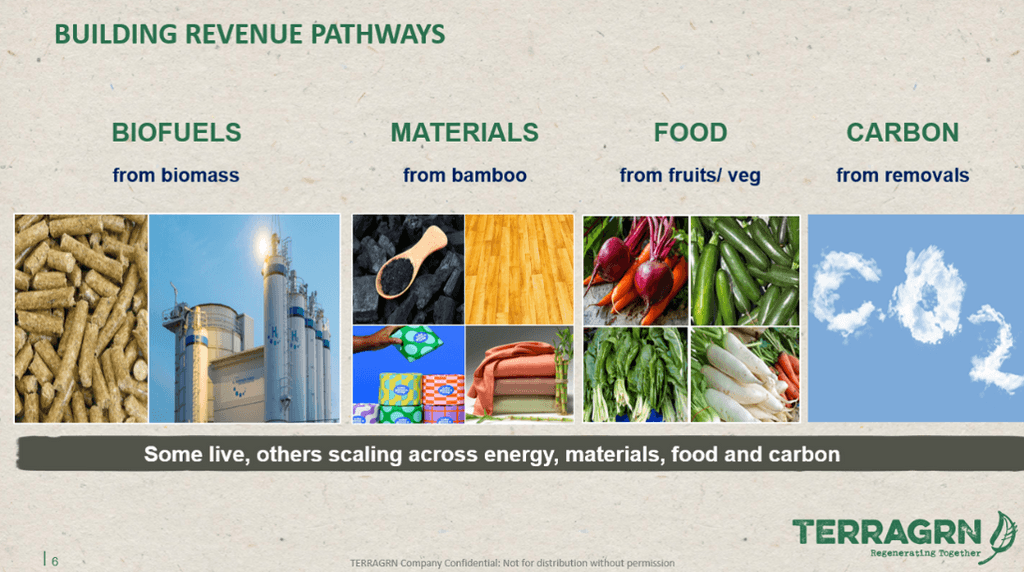
TerraGRN's response was to design a system with multiple, sequenced revenue streams rather than relying on a single one like carbon. Near-term cash flow comes from clearing invasive biomass, generating energy and timber revenue. As the system matures, higher-margin products such as bamboo engineered boards and activated carbon come online, with carbon value building over the long term. This diversified model, Sundar argues, is what makes nature-based ventures resilient as an asset class, rather than dependent on a single revenue stream.

"What become very clear for us early on is that restoration of landscapes and markets they exist in parallel, but they don't connect and let capital flow smootlhy for various reasons that prevent scale".
— Sundar Bharadwaj, CEO of TerraGRN
From sustainability topic to financial decision
Awareness of nature-related risk varies sharply by sector. Vincent noted that companies in agrifood, cosmetics, and luxury increasingly understand that their business depends directly on nature, making it a strategic issue rather than an ESG checkbox. Elsewhere, many executives still underestimate that nature-based risk is systemic, touching water, land, and pollution, not just carbon.
A key misconception, he added, is benchmarking regenerative agriculture against "business as usual." In reality, climate risk is already financially impacting operations today, so the right comparison is against a risk-adjusted baseline. Companies that have quantified their physical and financial exposure are far better positioned to pursue long-term contracts and supply chain reintegration.
"What's the business model of regenerative agriculture, and they want to understand it against their business as usual. But that's the mistake. Because climate risks are already there and financially material and impacting their model today. So we if want to have proper understanding of the business case of RegAg, you should compare it against risk adjusted business as usual and not to "business as yesterday"
— Vincent Kientz, Co-Founder of Blunomy
The real constraint: translation, not capital
Perhaps the most important insight from the conversation: the binding constraint isn't capital, it's translation. Investors struggle to price nature-based ventures because they don't yet know how to treat them as infrastructure rather than one-off projects.
Bridging that gap requires three things: revenue visibility through diversified, ideally contracted cash flows; clear allocation and pricing of biological, policy, and market risks; and proper structuring that lets systems generate income rather than depending on continuously funded impact.
Drawing on Blunomy's work with TerraGRN in its first 18 months, the discussion highlighted how translating a restoration concept into a theory of change, financial model, and value chain economics created the clarity investors needed, and surfaced a deeper issue: ecosystems still aren't valued as assets on corporate or institutional balance sheets, even though they deliver continuous services well beyond the products extracted from them.
Scaling to 10,000 hectares
TerraGRN is now moving from its successful 50-hectare pilot to a 10,000-hectare phase. Bharadwaj outlined five priorities: institutional depth (supported by a new partnership with C4 for science leadership), blended finance anchored by catalytic equity, strategic offtake agreements for bamboo, carbon, and food, capital for downstream processing, and, critically, a shift toward valuing the integrated system rather than individual products.
Looking ahead
Sundar and Vincent agreed that scaling nature-based solutions by 2030 will require three things moving together: clear revenue visibility, properly managed risk, and patient, long-term capital. As more companies quantify climate risk in financial terms, not just qualitative ratings, the appetite to invest in nature as a resilient, diversified asset class is expected to grow.


