Decarbonisation Decoded: why electrification is becoming the backbone of resilience
Newsroom, October 2026
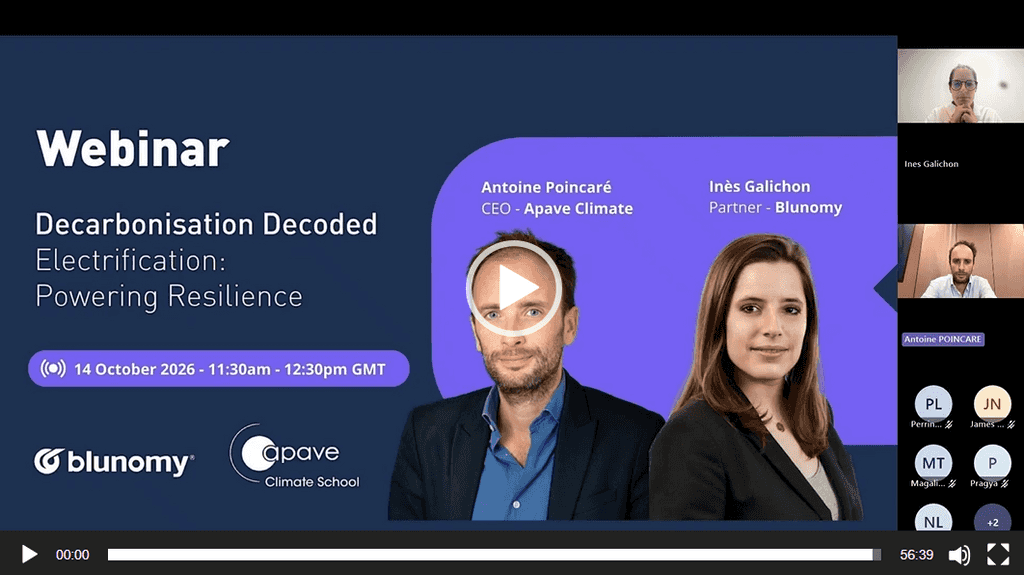
Electrification is moving from a sustainability topic to a business priority. In the first episode of our Decarbonisation Decoded webinar series, Inès Galichon (Partner, Blunomy) and Antoine Poincaré (CEO, Apave Climate) explore why electricity is set to define the coming decade, and what that means for companies, investors and financial institutions.
Adapting and decarbonising at the same time
The discussion opened with a reminder of the double urgency facing businesses: adapting to climate impacts that are already visible across Europe, and continuing to cut emissions. Limiting warming to 1.5°C now looks increasingly unlikely, but the speakers argued that the picture is more encouraging when you look beyond global averages. Solar generation has doubled in just three years, renewable output is outpacing many earlier forecasts, stationary batteries have expanded rapidly, and electric vehicle sales continue to set records.
Entering the Age of Electricity
A central theme was the gap between what is already electrified and what could be electrified today. Roughly a fifth of global energy demand is electric so far, yet the International Energy Agency considers that many uses have already reached the point where switching is financially attractive. Around half of residential fuel use could move to heat pumps, around half of road transport energy could be supplied by electric vehicles, and roughly 40% of low- and medium-temperature industrial heat can already be electrified with existing technology. For economies that depend heavily on imported fossil fuels, this shift also means greater energy sovereignty and less exposure to price shocks.
Electrification in practice: costs, sectors and resilience
Falling costs for renewable power and batteries are the main engine behind this momentum. The speakers pointed to a solar-plus-storage project in Abu Dhabi that competed with coal-fired generation while delivering electricity around the clock. Batteries make this possible by storing surplus renewable output and releasing it when demand peaks.
The most concrete part of the discussion looked at sectors often considered difficult to decarbonise. Electric trucks are gaining ground fastest where fleet operators reason in total cost of ownership rather than purchase price. In maritime transport, large electric ferries already run on short routes and battery-powered container ships are emerging in regional trade. Data centres add a different kind of pressure, accelerating the need for low-carbon generation and grid modernisation.
The webinar also challenged the idea that decarbonisation is mainly a cost. Inès Galichon presented an industrial case from the agri-food sector, where a company identified profitable projects (heat pumps, renewable generation, energy efficiency and circular energy solutions using by-products) forming a €30 million investment plan that combined significant emissions cuts with attractive returns. Heat pumps stood out as an under-appreciated lever, and newer financing models make it possible to invest without carrying the full upfront capital cost.
Beyond emissions and savings, the speakers introduced the notion of electrofortification: generating, storing and managing energy locally through electric vehicles, heat pumps, rooftop solar and batteries. The more energy an organisation produces and stores on its own, the less exposed it is to geopolitical tensions and volatile fuel markets.
The grid: the real bottleneck, and what comes next
Electrification faces one major constraint, and it is not technological. Every electric vehicle, heat pump, battery, data centre and renewable project depends on grid capacity, and much of Europe’s electricity infrastructure is ageing. Renewable projects are often developed faster than grids can connect them, and networks must become more flexible to handle decentralised generation. Without significant grid investment, electrification risks being limited by infrastructure rather than by technology.
Still, technology transitions tend to look slow until they reach a tipping point, as household appliances, mobile phones and the internet did. Electrification appears to be on a similar path. As costs fall and adoption spreads, its benefits extend well beyond emissions, to lower operating costs, greater resilience and stronger energy security. Barriers remain, but the Age of Electricity is clearly taking shape.
Watch the replay
Missed the live session? The full discussion between Inès Galichon and Antoine Poincaré is available on the Apave Climate School website → watch the replay
About the partners
Blunomy is a specialist strategy advisory firm working to accelerate the climate and energy transition. Its teams combine sector expertise, data science and proprietary tools, including Horizon, Vision, ORBIT and the Climate Risk Assessment Tool, with hands-on business and investment experience. Blunomy supports financial institutions, private capital players, energy companies and industrial groups from its offices in Paris, London, Singapore, Melbourne and Sydney.
Apave Climate School is the training and awareness arm of Apave Climate, formerly AXA Climate. It helps organisations engage their teams on climate and sustainability through e-learning modules, short video formats and live training.
The Net Zero School is a partnership between Blunomy and Apave Climate School. It is a fully digital training programme that helps professionals understand how their clients and partners can decarbonise, sector by sector, from long-term decarbonisation scenarios to concrete, short-term transition actions. The catalogue covers more than ten sectors, is regularly updated, is available in French and English, and can be deployed through an existing learning platform or the Net Zero School platform, with white-label options.
→ Banks, investors, law firms and consultancies work every day with clients whose decarbonisation choices shape their own risks and opportunities. The Net Zero School gives your teams the sector-by-sector knowledge to understand those transition pathways and advise on them with confidence. Discover the Net Zero School and see whether it fits your teams.